
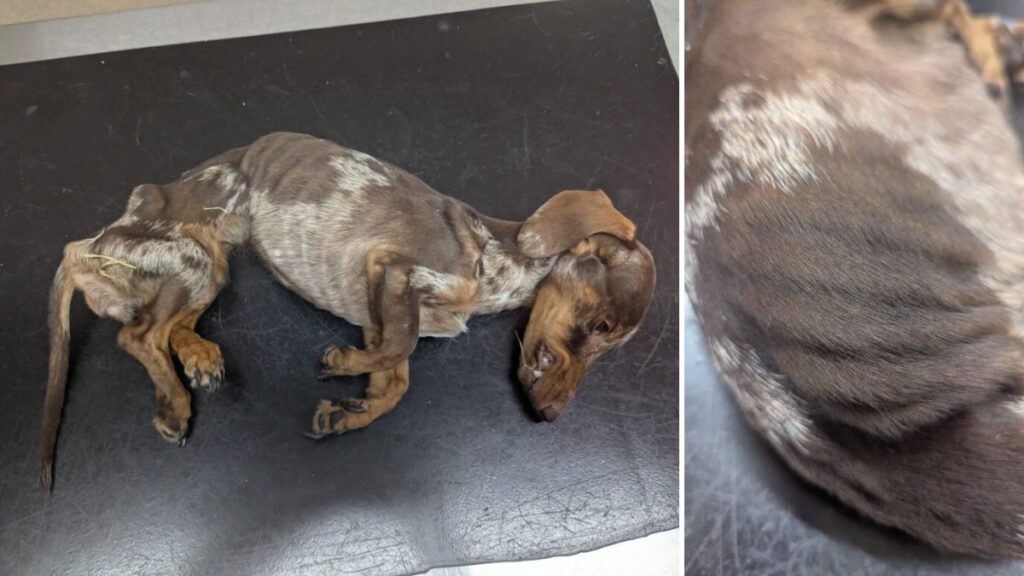
Anna Louise Fennessey has been given a 15-month prison sentence, suspended for two years, after admitting she caused unnecessary suffering to her two-year-old dachshund, Koda.
Koda’s body was found by a member of the public, so thin that her ribs, spine and hip bones were plainly visible.
The sentence
Fennessey, of no fixed abode, was sentenced at Cardiff Crown Court on Friday 13 November. As well as the suspended term, the court imposed:
- A probation requirement
- A 12-month drug rehabilitation requirement
- A five-year disqualification from keeping dogs
She also received a four-week suspended custodial sentence for a separate Bail Act offence, to run consecutively.
The offences admitted
- Causing unnecessary suffering to a protected animal, contrary to Section 4(1) of the Animal Welfare Act 2006
- A Bail Act offence
The animal welfare charge covered the period from 7 February 2025 to 8 April 2025, at Pant in Merthyr Tydfil or elsewhere. It stated that she failed to adequately investigate or address the causes of Koda’s poor or underweight condition, when she knew or ought reasonably to have known this would cause, or be likely to cause, unnecessary suffering.
How Koda was found
A member of the public discovered the dog’s body on 8 April 2025 and took it to a vet. The case was then reported to the RSPCA.
RSPCA Deputy Chief Inspector Gemma Cooper went to the veterinary practice the same day. She later used Koda’s microchip details and further inquiries to trace Fennessey as the owner.
In a written statement to the court, she described a dog that was “extremely emaciated”. She said: “You could see every rib, her spine, her shoulders and her hip bones and she weighed a mere 2.15kg.”
The veterinary evidence
The vet who examined Koda found unhatched fly eggs by her teeth, a sign she had been dead for a day or two. She scored one out of nine for body condition, which indicates severe emaciation, and no muscle mass could be felt anywhere on her body.
In a written report, the vet said:
“Assuming she had been at normal weight, in my experience it would take between two and three months of total starvation (water only) to get to this state from normal, suffering from severe hunger for the entire time, longer if she had any food during that period.
“Any illness could have accelerated the process but it would still have been a prolonged period of suffering regardless with obvious signs that veterinary attention should have been sought.”
A post mortem examination found no underlying cause for Koda’s extreme weight loss. Responding to its findings, the vet added:
“The report states that starvation is unlikely as the cause of death but with no underlying cause found for the extreme weight loss, I find it likely that the level of starvation detailed in my previous report is the most likely cause of the weight loss with the cardiac damage leading directly to the animal’s death coming after a prolonged period of starvation.”
Mitigation
The court heard Fennessey had been going through a significant personal crisis at the time and that she feels regret and remorse.
The RSPCA’s response
Speaking after the hearing, Deputy Chief Inspector Cooper said:
“Sadly Koda was not able to be saved and it is heartbreaking to think what she went through. All animals deserve to be treated with kindness and should have their needs met.”






Comments
Comments on this story are checked before they appear. Please don’t name anyone the story doesn’t, or say anything about guilt or the evidence.
No comments yet. Be the first to have your say.