(Image: YouGov)
Last Updated: 6 May 2026
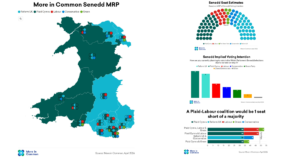
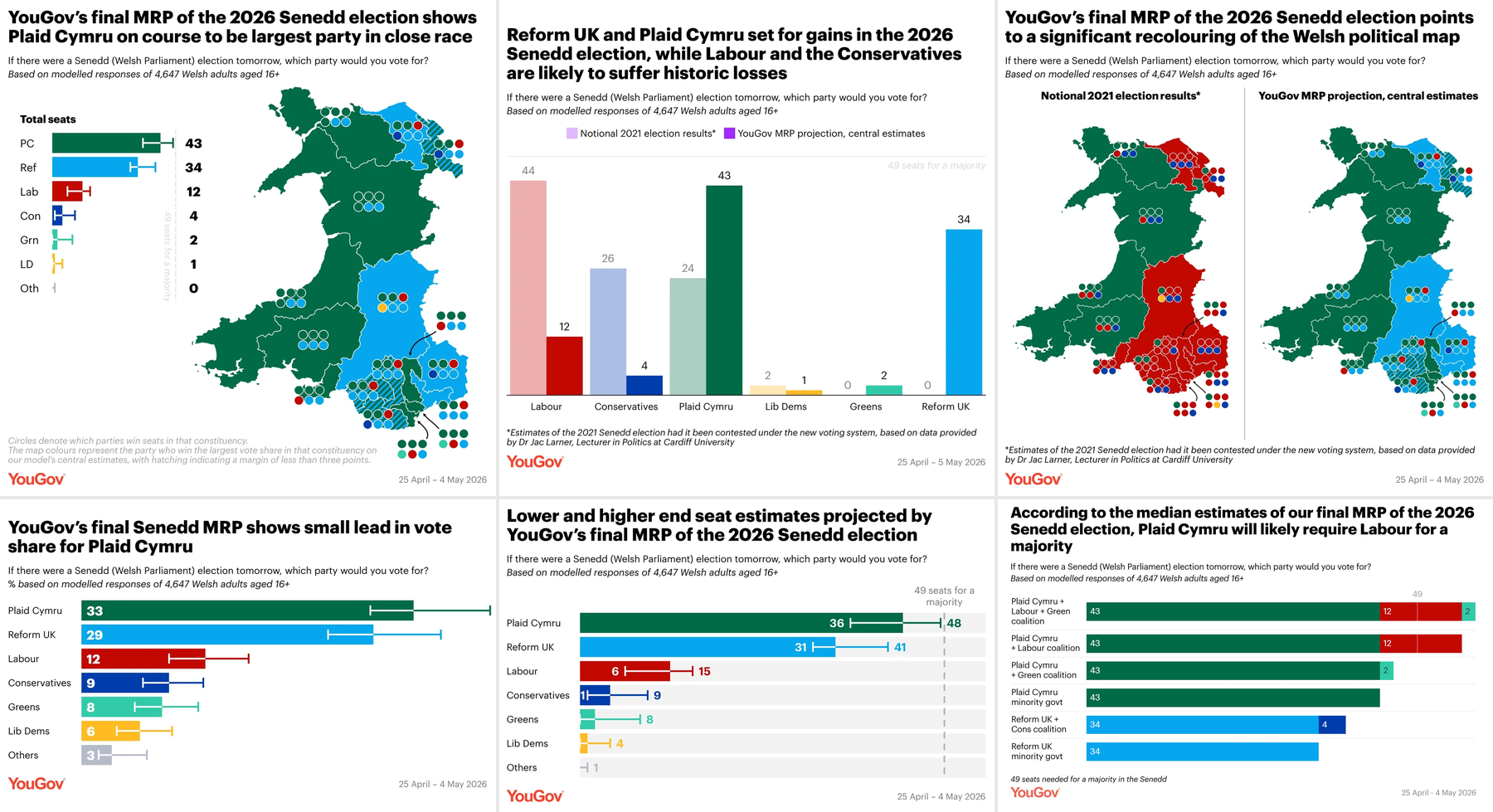
More than a hundred years of Labour topping the poll in Wales could be coming to an end, according to the final YouGov MRP projection for ITV Cymru Wales published ahead of tomorrow’s Senedd election.
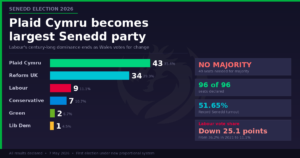
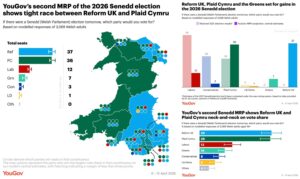
The model, based on responses from over 4,600 adults surveyed between 25 April and 4 May, places Plaid Cymru as the likely largest party in the newly expanded 96-seat Senedd, with a central estimate of 43 seats – just six short of an outright majority.
Labour’s historic losses
The scale of Labour’s projected decline is stark. The party is forecast to win just 12 seats in the Senedd – a notional loss of 32 compared with the 2021 result under the new electoral system. Their projected vote share of 12% would represent a drop of 24 points and their worst performance at any major Welsh election since 1906.
According to YouGov’s model, Labour fail to finish as the leading party in any of the Senedd’s 16 constituencies, and are projected to pick up zero seats in four of them. In the western constituencies, the party’s support is estimated to have fallen to single figures.
The projection raises the prospect that First Minister Eluned Morgan could lose her own seat. She heads Labour’s candidate list in Ceredigion Penfro, one of the constituencies where the party’s share has collapsed furthest.
A symbolic shift
Perhaps nowhere captures the transformation more than the Pontypridd Cynon Merthyr constituency, which covers the Merthyr Tydfil area where Keir Hardie was elected as Wales’s first Labour MP in 1900. YouGov’s central estimates show Reform UK narrowly ahead there on 34%, with Plaid Cymru on 33% and Labour trailing on just 14%.
Reform UK’s rise
Reform UK are projected to finish second overall with 34 seats in the median estimate, a dramatic surge from the 1% vote share they recorded at the 2021 election. Their support is relatively evenly spread across Wales but dips in the two Cardiff constituencies, while their strongest performances are projected in the south Wales valleys. The party emerges as the largest party in 13% of YouGov’s simulations, with their projected seat range running from 31 to 41.
Smaller parties squeezed
The Conservatives face their worst devolved election result to date, with a central projection of just four seats – down from a notional 26 in 2021. That total would leave them one seat short of the five required to form a political group in the Senedd, restricting their ability to chair committees or question ministers.
The Greens are on track to win representation in the Senedd for the first time, with a projected seat in each of the two Cardiff constituencies. Their estimated 8% vote share would be a Welsh record for the party, though their seat projection has fallen considerably from the ten suggested in YouGov’s pre-campaign model, indicating their vote has been squeezed during the campaign period.
The Liberal Democrats are projected to hold a single seat, in the Brycheiniog Tawe Nedd constituency, meaning Jane Dodds would remain the party’s sole MS.
Coalition arithmetic
No party is expected to secure a majority, meaning cooperation will be needed to elect a first minister. YouGov’s modelling suggests the path to government runs firmly through Plaid Cymru. A combined right-of-centre majority for Reform UK and the Conservatives appears in just 1% of simulations.
Although Plaid Cymru leader Rhun ap Iorwerth has indicated a preference for a minority government with only Plaid ministers, the polling suggests he would most likely need Labour’s support to command a Senedd majority. The two parties together cross the 49-seat threshold in 89% of simulations. A Plaid-Green arrangement reaches a majority in only 9% of runs.
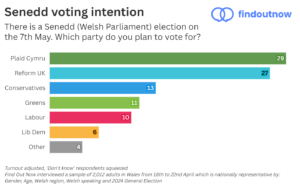
Across Wales, Plaid Cymru lead on projected vote share with 33%, four points clear of Reform UK on 29%. The Conservatives are on 9% and the Liberal Democrats on 6%.
The new D’Hondt voting system means seat allocations are highly sensitive to small shifts in support. YouGov notes that in several constituencies, the difference between parties winning or missing out on the final seat comes down to fractions of a percentage point.