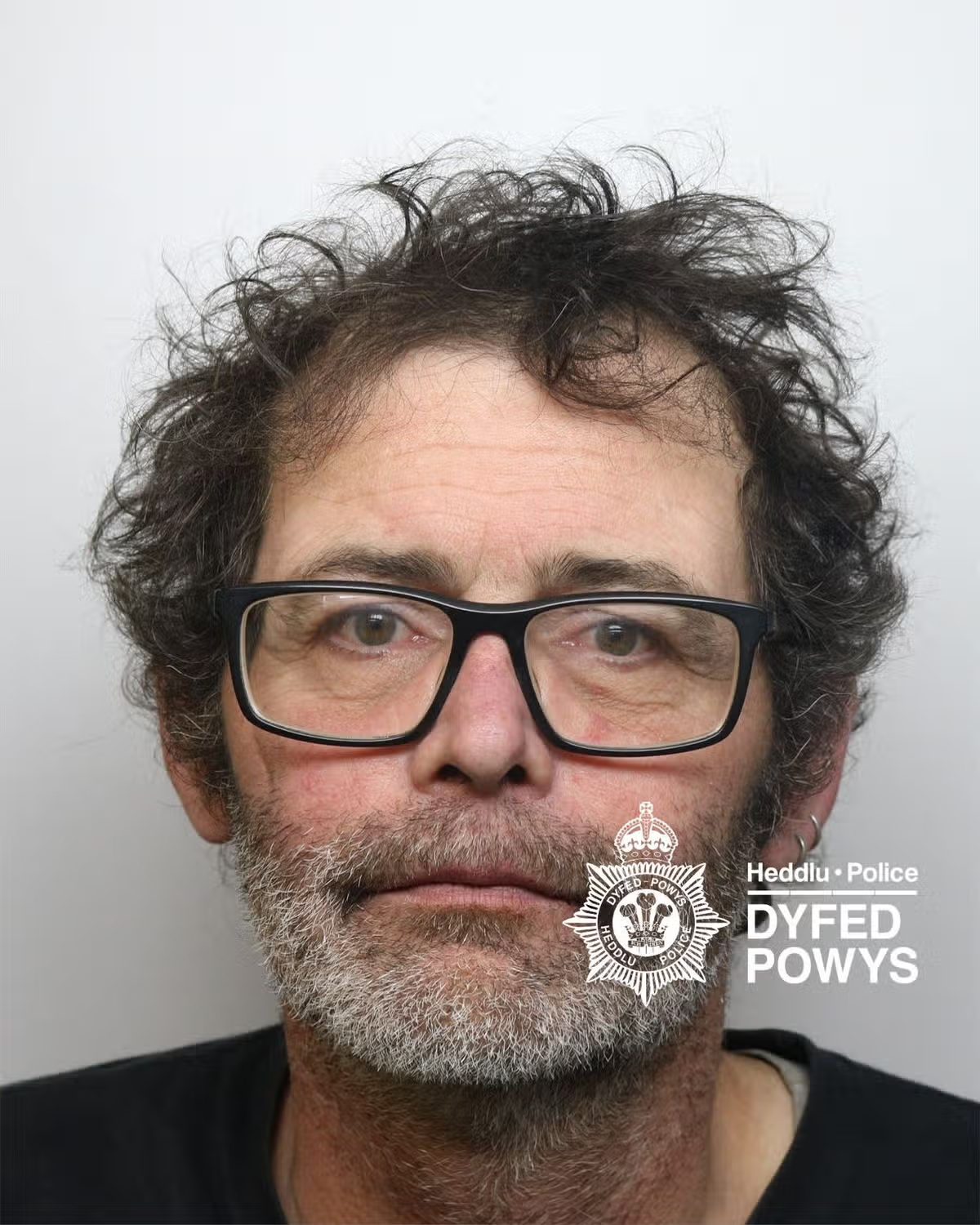

Leighton Burgess (Image: South Wales Police)
Last Updated: 22 June 2026
Leighton Burgess has been sentenced to three years in prison after police linked a string of drug supply messages to phones found in his possession at a Port Talbot hostel.
The 38-year-old, of Talbot Road, admitted three offences at Swansea Crown Court – being concerned in the supply of cocaine, being concerned in the supply of Valium, and being concerned in the supply of pregabalin.
Burgess entered his guilty pleas on the basis that a long-standing addiction to Class A drugs had driven him to sell to a small group of associates in order to fund his own habit. He said the group would also sometimes combine their money to buy drugs at a more favourable price.
The investigation
Prosecutor Matt Murphy explained that Burgess first came to the attention of officers in April this year when police in Port Talbot examined the phones of known drug users. That analysis identified a number of phone numbers that had been used to distribute messages advertising the sale of controlled substances, and those numbers were subsequently traced back to the defendant.
The arrest
On April 25, Burgess was stopped and detained while walking along Station Road. He was found to be carrying a Nokia handset using one of the numbers officers had already identified. An examination of the device revealed messages connected to the supply of cocaine, Valium, and pregabalin – a prescription-only medication.
What police found at the YMCA
A subsequent search of Burgess’s room at Port Talbot YMCA uncovered a further four mobile phones along with two SIM cards.
His explanation
When interviewed by police, Burgess acknowledged spending around £600 a month on crack cocaine out of a monthly benefits income of £1,100. Despite this, he denied being the person behind the drug supply messages, telling officers that other people living at the YMCA had been able to use his phone.
Criminal record
The court was told Burgess has amassed 16 previous convictions covering 45 separate offences. Among them are cannabis trafficking convictions from 2010 and 2013, and a conviction for possession of heroin with intent to supply dating from 2016. His most recent offence was a driving matter in 2020.
Personal circumstances
Defence barrister Ian Ibrahim told the court that Burgess has ADHD and left formal education at the age of 14. He said it was perhaps a reflection of how his client’s life had turned out that Burgess described the YMCA as the best place he had ever lived.
Mr Ibrahim said “by any standards” his client has a “poor circle of friends”.
The barrister explained that Burgess had been “devastated” by the death of his mother, with whom he had been particularly close. He has no contact with his father, who lives in Thailand.
Mr Ibrahim added that since being held on remand, his client had been drug-free, had completed a number of courses, and now “looks and feels better”.
Sentencing
Recorder Barry Clarke acknowledged that a pre-sentence report had outlined how living at the YMCA had brought some stability to Burgess’s life. However, the recorder pointed to a “persistent pattern of drug misuse and associated offending” and concluded that community rehabilitation was not a realistic prospect in the circumstances.
Recorder Clarke warned Burgess that if he were to be caught dealing Class A drugs for a third time, the sentence would start at seven years.
Burgess received a one-quarter reduction for his guilty pleas, bringing the sentence to three years. He will serve 40 per cent of that term in custody before being released on licence to complete the remainder in the community.